
Lightbox Rubber Strips
for Fabric Lightbox Frames
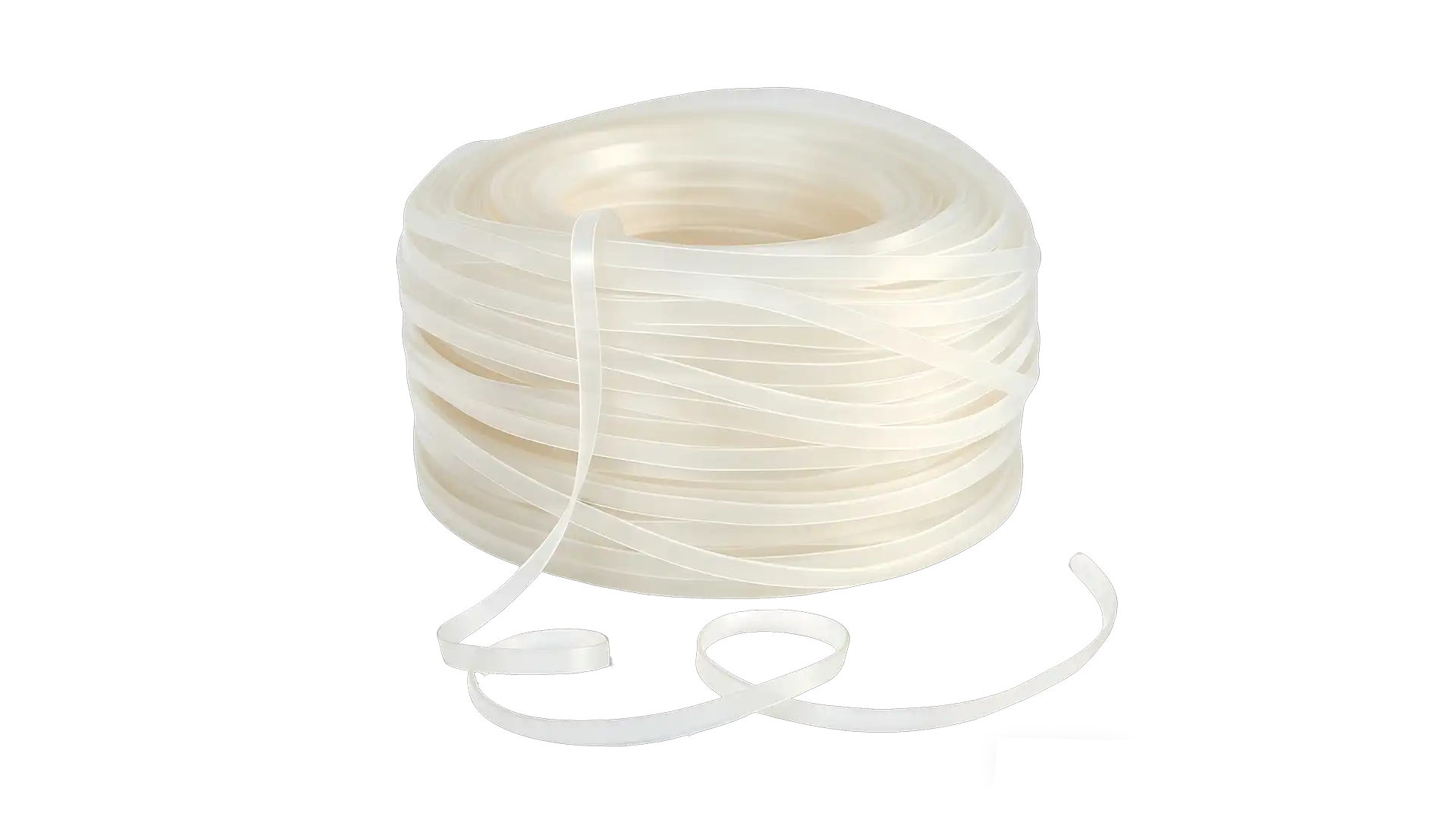
Medical-grade PVC and flame-retardant TPE edge strips for fabric lightboxes — 3mm thick, 10 / 12 / 14mm widths, REACH and ROHS compliant, cut to your own lengths.
- 10 · 12 · 14 mmStrip width
- 3 mmThickness
- PVC · TPEMaterial options
- REACH · ROHSCertification
- 01
Plug into the profileThe strip presses straight into the groove of the aluminium extrusion — no adhesive, no tools.
- 02
Insert the fabric edgeThe sewn edge of the printed graphic slides into the open channel on the other side of the strip.
- 03
Tension holds it flatThe frame can be re-skinned on site, which keeps retail and trade show graphics changeable.
Elastic or Not: How Far It Goes and What Comes Back
Elongation at break tells you where a strip tears; on a frame the question is how far it will give and still return. The two strips below are cut to the same length — the pale band marks the furthest each one travels before it comes back.
PVC comes back as well — it is simply the stiffer compound, so only about 3 % of give is available before it fights back, which is why a PVC strip is cut tight rather than stretched into place. TPE takes about 1.3× its cut length and returns to it, which is what lets it ride with a stretch fabric.
On a fabric frame this is the line between the two. A stretch fabric (backlit textile) keeps pulling long after it is tensioned, so the strip has to give with it: TPE does, and the sewn edge stays in the groove. PVC has only about 3 % to give — not enough to follow that pull, so the edge works loose and the panel wrinkles; with PVC, print on a stable woven fabric.

Where the edge sealing strip sits in a fabric lightbox
In a fabric-framed lightbox the strip is a small part doing a structural job. It is the bridge between the aluminium profile and the printed fabric: the sewn edge slides into the channel on one side of the strip, the strip itself presses into the groove on the other, and the graphic is held flat instead of shifting, sagging or dropping out during handling. That is what keeps a panel reading as one clean surface — and what lets the same frame be re-skinned on site years later instead of replaced.
The strip also seals. Moisture, dust and debris stay outside the box, away from the LEDs, power supply and wiring, and both materials carry UV and ageing resistance built in, so the seal still holds after a run of trade shows, a retail rotation or a season outdoors.
Pictured: sewn edge pressed into the channel at a frame corner (3 mm × 12 mm TPE).
4 Professional Production Lines
Dedicated lines run lightbox rubber strip for fabric lightbox frames, matched to every profile we sell. Custom widths and shaped runs are quoted from your drawing.
- Four extrusion linesStrip is drawn in our own plant, not bought in
- Fits every lightbox profile10 / 12 / 14 mm grooves, plus custom widths
- Cut to your lengthsStraight runs or shaped frames, cut before shipment
Why Choose Our Lightbox Rubber Strips?
- Medical-grade PVC or flame-retardant TPE — both low-VOC and odor-free.
- Drops into any aluminium extrusion, so assembly needs no adhesive.
- REACH, ROHS2.0 and EN71-3 test reports shipped with the order.
PVC vs TPE Strip: Specifications Side by Side
Both materials drop into the same profile — the rows below are where they actually differ, and the three charts that go with them show where that difference bites. Everything under the second heading is the same for both, because it is the specification of the strip we cut, not of the compound.
| Feature | Low-VOC PVC Strip | TPE Strip |
|---|---|---|
| Material | Soft PVC compound, medical grade | Thermoplastic elastomer, industrial grade |
| VOC / Odor | Low-VOC formula, near odorless | Naturally odorless |
| Specific gravity | 1.19 ±0.03 g/cm³ISO 1183 | 0.87 ±0.02 g/cm³ISO 1183 |
| Hardness | 70 ±3 Shore AISO 868 | 55 ±3 Shore A (softer)ISO 868 |
| Tensile strength | ≥11 MPaISO 37 | ≥5 MPaISO 37 |
| UV resistance | Indoor use bestISO 4892-2 | Indoor & outdoor, with stretch fabricISO 4892-2 |
| Temperature range | −15°C to 60°C | −40°C to 80°C |
| Elongation at break | ~380 % at break · elastic give ≈3 %ISO 37 | Up to 650 % at break · elastic give ≈1.3×ISO 37 |
| Stretch fabric (backlit textile) | Not for stretch fabric — 3 % give cannot follow the pull | Works · the strip gives with the fabric |
| Colour | Clear transparent | White, black or to your colour |
| Recyclable | Limited | Yes (100% recyclable) |
| Cost | Budget-friendly | ~30% premium |
| Best for | Indoor retail, shows, budget jobs | Outdoor, EU/US eco buyers, premium builds |
| Same for both materials — strip specification | ||
| Strip width | 10 / 12 / 14 mm · custom on request | |
| Thickness | 3 mm | |
| Phthalate-free | Yes — both compounds, our standard | |
| Certification | REACH · ROHS2.0 · EN71-3, test reports shipped with the order | |
| Supply form | Cut to your lengths, straight runs or shaped frames | |
| Profile fit | All standard aluminium extrusions | |
| Standard pack | 300 m per roll · cut to your lengths | |
| Custom pack | Paper tube, cardboard spool, logo, plywood case (extra fee) | |
| Test atmosphere | 23 ±2 °C · 50 % RH before testing — ISO 291 | |
Where each compound works
PVC stops at +60 °C and starts at −15; TPE starts 25 °C lower and runs on to +80. Behind a lit panel in a sealed box, that is the difference between a strip that stays soft and one that slowly takes a set.
Shore A, the finger test in numbers
70 Shore holds the fabric tighter and resists pull-out when the graphic is stretched; 55 seats more easily in a tight groove and is kinder to a thin fabric. Both read 15 s after contact, per ISO 868.
Same 3 mm, three widths
All three sections are 3 mm deep, so the profile depth never changes — only the groove width does. 12 mm is the default; 10 mm suits a narrow slot, 14 mm fills a wider one or carries a heavier fabric.
Note — typical values, not a guarantee. Every figure in the table and the charts is a typical average from a test batch at 23 ±2 °C and 50 % RH, within the tolerances shown; the compound was measured, not the finished frame. Values are subject to revision without notice and none of them is a contractual term — the specification that binds is the one on your quotation and order confirmation. Tell us the profile, the fabric weight and whether the box lives indoors or out, and we will confirm the grade and the paperwork for that build.
- ISO 37 — tensile stress, tensile strength and elongation at break for rubber and thermoplastic elastomer compounds.
- ISO 868 / ASTM D2240 — Shore A durometer hardness, read 15 seconds after contact.
- ISO 1183 — density and specific gravity of plastics.
- ISO 291 — the standard atmosphere the samples are conditioned in before testing.
- ISO 4892-2 — xenon-arc weathering, the test behind the indoor / outdoor distinction.
- REACH (EC 1907/2006) and RoHS 2011/65/EU — substance restrictions; EN 71-3 — migration of certain elements.
What We Check Before a Rubber Strip Order Ships
Every carton leaves only after these six checks. The strip comes off the line extruded from compounded pellets, so the grade and the colour are fixed before it reaches the die — and a cut length from each batch stays with us against your next order.
Cross-section and lip
Caliper on a cut length: width and thickness to the ordered size (14×3, 12×3, 10×3), and the lip measured against the profile drawing it has to clip into.
Compound and masterbatch
Grade and colour are set in the compound from masterbatch, not sprayed on afterwards. The masterbatch lot goes on the batch record, so a repeat order comes back the same shade instead of ‘close enough’.
Hardness and recovery
Shore A against the grade on the order — PVC and TPE never read the same. Then a length stretched to the agreed elongation, released, left to settle and measured for set: if it does not come back, the roll does not ship.
Colour through the body
A cut end reads the same colour as the surface — that is how a compounded strip is told from a coated one. Even tone along the coil, no bubbles, die lines or talc patches; food-grade lots also get the odour check before bagging.
Metres, ends and coil
Metres per coil to the order, ends cut square rather than torn, no kinks where the coil was banded — those kinks are what make a strip refuse to sit in the groove.
Packing and paperwork
Moisture bag, batch label carrying colour, size and masterbatch lot, carton count re-counted at the pallet. Photos, packing list and the retained sample travel with the shipment.
If a check fails it is re-run or re-made before packing, not negotiated after the container lands. Tolerances are the ones on your drawing and quotation — we do not publish a blanket ± figure, and the note above the comparison table still governs every number on this page.
Frequently asked questions about lightbox rubber strips
Widths, thickness, PVC versus TPE, and whether the strip fits the frame profile you already have.
All strips are 3mm thick and come in 10mm, 12mm and 14mm widths, the three sizes used by most fabric lightbox frames. Other widths and thicknesses can be produced on request.
PVC is the budget-friendly option for indoor retail and trade show frames. TPE costs around 30% more but takes outdoor UV, springs back from about 1.3x its cut length and is fully recyclable, which makes it the usual choice for EU and US projects with eco requirements. On a stretch fabric (backlit textile) only TPE works: the fabric keeps pulling after it is tensioned, and TPE’s 1.3x give lets the strip move with it, while PVC’s 3 % is not enough.
Yes. Both PVC and TPE strips meet REACH, ROHS2.0 and EN71-3, and our PVC compound is low-VOC and phthalate-free. Test reports can be sent with your order.
They are made for standard lightbox aluminium extrusions: the strip is pushed into the profile groove and the graphic edge is inserted into it, with no adhesive needed. If your frame uses a non-standard profile, send the groove drawing and we will match the strip to it.
Yes. Strips are supplied cut to the lengths you specify, and custom shapes are possible for non-rectangular frames. Send the frame dimensions and quantity for a quote.