
UV Printable PET Sheet
for Advertising Display
High-clarity APET / PETG / GAG sheets for lightbox graphics and retail packaging — 0.3–1.0mm thickness, UV and screen printable, produced in a Class 100,000 dust-free workshop.
- 0.3–1.0 mmThickness range
- APET · PETG · GAGMaterial options
- UV + ScreenPrint methods
- Class 100,000Dust-free workshop
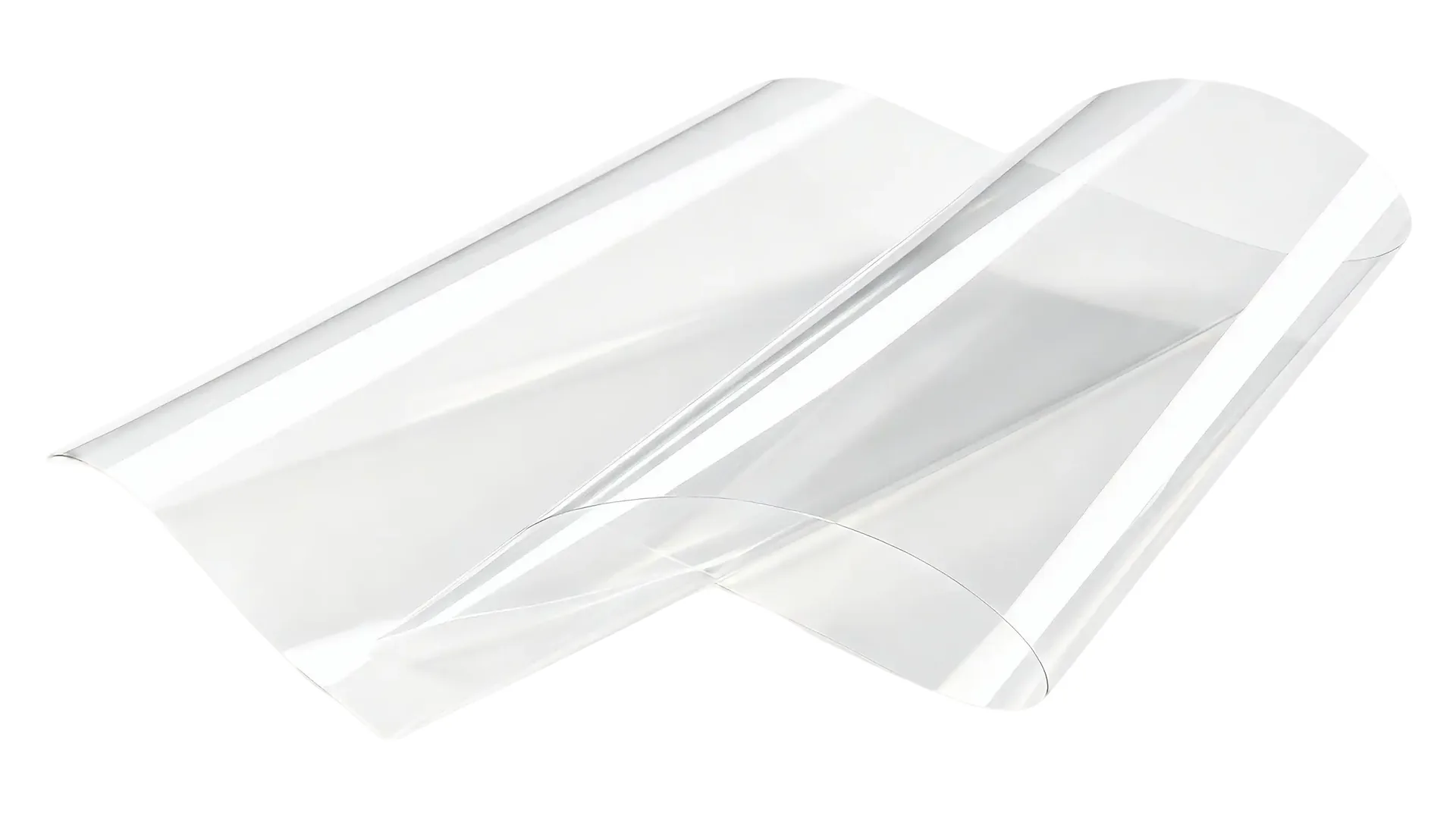
Made on a dust-free line
- Class 100,000Cleanroom grade of our line
- 10x cleanerThan regular workshops
- Zero dust spotsOn printed surfaces
Key Advantages of Our Printable PET Sheets
- UV & Screen Print Compatible High ink adhesion for vivid, scratch-resistant advertising graphics
- Excellent Flatness No warping, perfect for large-format lightbox displays
- Multiple Materials APET / PETG / GAG options for different durability & clarity needs
APET, PETG and GAG: Same Family, Different Build
All three are polyester sheet, printed and recycled the same way. What changes is the build — APET is one amorphous layer, PETG is one glycol-modified layer, and GAG is a three-layer sandwich of PETG skins over an APET core. The core sets the stiffness; the skins set what the surface does. APET and GAG both end up as the lightbox face sheet: printed, then mounted on the front of the box, with a light guide plate and LEDs behind it — or, where there is no light, simply as a printed graphic panel. GAG is the one to pick when the same face also has to fold, weld or die-cut.
- Lightbox face sheet
- Flat sign & poster panels
- Formed 3D letters
- Tough display parts
- Lightbox face sheet
- Folded & welded lightboxes
- Die-cut display parts
GAG is a derived band: read off the APET core and the PETG skins, not a single-resin test.
- Lightbox face sheetsAPET for a flat printed face: stiff, and the lowest cost per square metre. GAG when the same sheet also has to be folded, welded or die-cut.
- Flat sign & poster panelsAPET — printed panels read by reflected light, where no light box sits behind the sheet.
- Folded & welded lightboxesGAG — the PETG skins take adhesive and high-frequency welding, so folded and welded corners hold, and die-cut edges stay clean.
- Formed letters & handled partsPETG — it bends far before it breaks, so it survives drawn letters and display parts that get knocked about on site.
Not sure which to quote? Send the artwork size, the frame and the finish — we answer with the sheet, the grade certificate and a sample.
How APET, PETG and GAG Print
Same ink, same printer, same 0.5–1.0 mm gauge — the sheet you feed decides what comes off the bed. Below is what changes in the print, not the chemistry: how each grade takes ink, how its base hides the light behind it, and what the finished face looks like under a lamp.
| Print behaviour | APET | PETG | GAG |
|---|---|---|---|
| Ink adhesionUV and screen | Strong. UV and screen ink both grab the surface, with no flaking at the edges of a dense solid. | Strong on the same inks, but the softer surface marks more easily under a fingernail or a stacking corner. | Strong and even. Ink sits on the PETG skins, so coverage stays uniform from the middle of the sheet to the trim edge. |
| Whites behind the LEDsOpaque face vs clear | Opaque neutral white. The light guide plate stays hidden and the printed face reads even, with no grey patches. | Clear by nature. As a printed face it needs a white backing sheet or a flood white pass, or the LED rows show through. | Hides like APET. The APET core does the opaquing; the skins lay a light gloss over that white. |
| Fine type & gradientsHairlines, vignettes | Crisp. Hairline type holds and gradients run smooth; ink stays on top of the surface instead of sinking in. | Crisp too, with slightly softer edge definition on the finest strokes and small reversed type. | Crisp on the skin, and the most even gloss, so gradients read smoother under raking light. |
| Gloss of the printed faceUnder a lamp | Glossy, evenly. A slight white under-tone keeps hotspot sheen low where LEDs sit close to the sheet. | Glossier and clearer, so hotspot reflections show more unless the print is dense. | Glossiest and most uniform — the look you want on a face read from a metre away. |
| Flatness after curingShrink at 90 °C | About 1 % across the sheet, so large panels stay flat through UV curing and mounting. | Up to 9 % across the sheet — expect curl on big panels unless you keep the sheet restrained. | About 5 % — flat enough for big faces, without APET's rigidity. |
| Folding, welding, die-cuttingAfter the print | Cracks on a sharp fold. Print it flat, cut it, then mount — do not bend a printed APET edge. | Folds and forms, but will not take a high-frequency weld. | Folds, welds and die-cuts with the print intact — the one for a box built after printing. |
| Scuffing in transitPrinted surface | Harder surface. The print survives stacking, banding and a long freight leg. | Softer. Scuffs show, so handle printed sheets with gloves and interleaving. | Scuffs like PETG on the skin, but the APET core keeps the panel flat and the edge square. |
Relative behaviour on our UV-printable grades, printed with the same inks; shrinkage figures are the supplier's 90 °C data. Grades vary — ask for a printed A4 sample before a large run.
Application Scenarios
Where this sheet ends up: behind a lamp, or folded into a clear box.
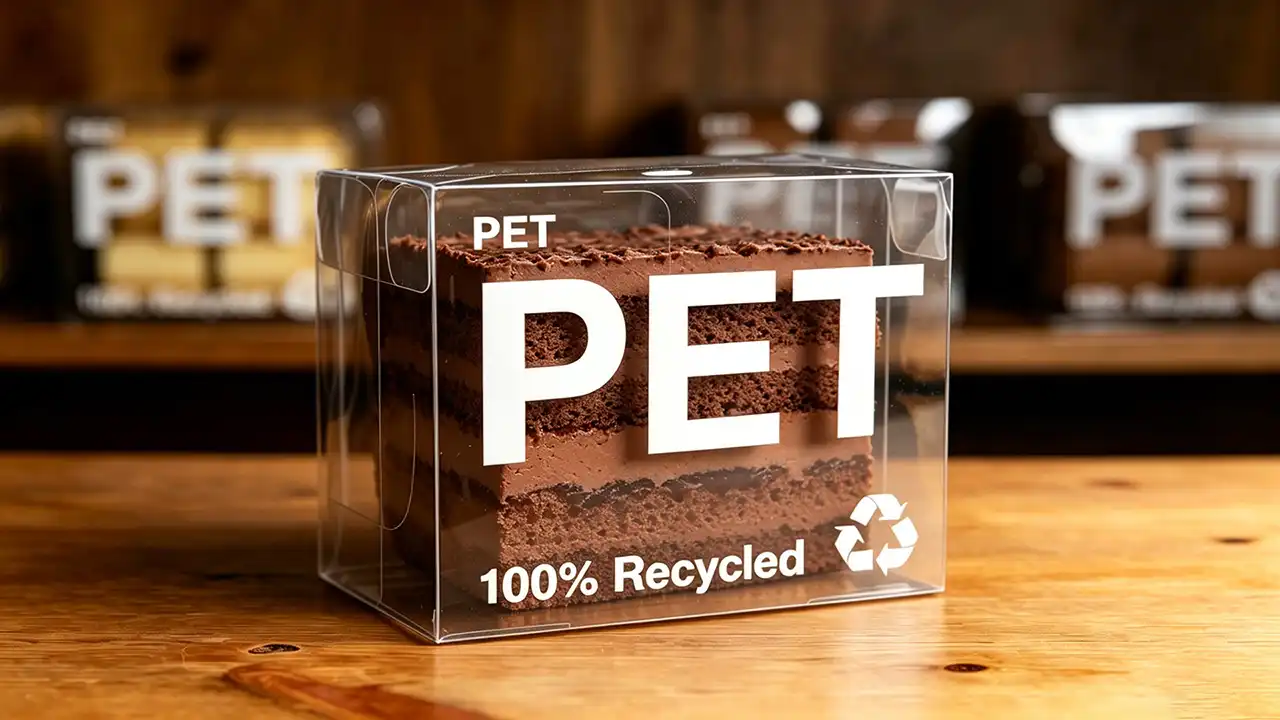
Food & Retail Packaging
High-clarity APET sheets for premium food boxes and retail display packaging, 100% recyclable with excellent UV printing performance.
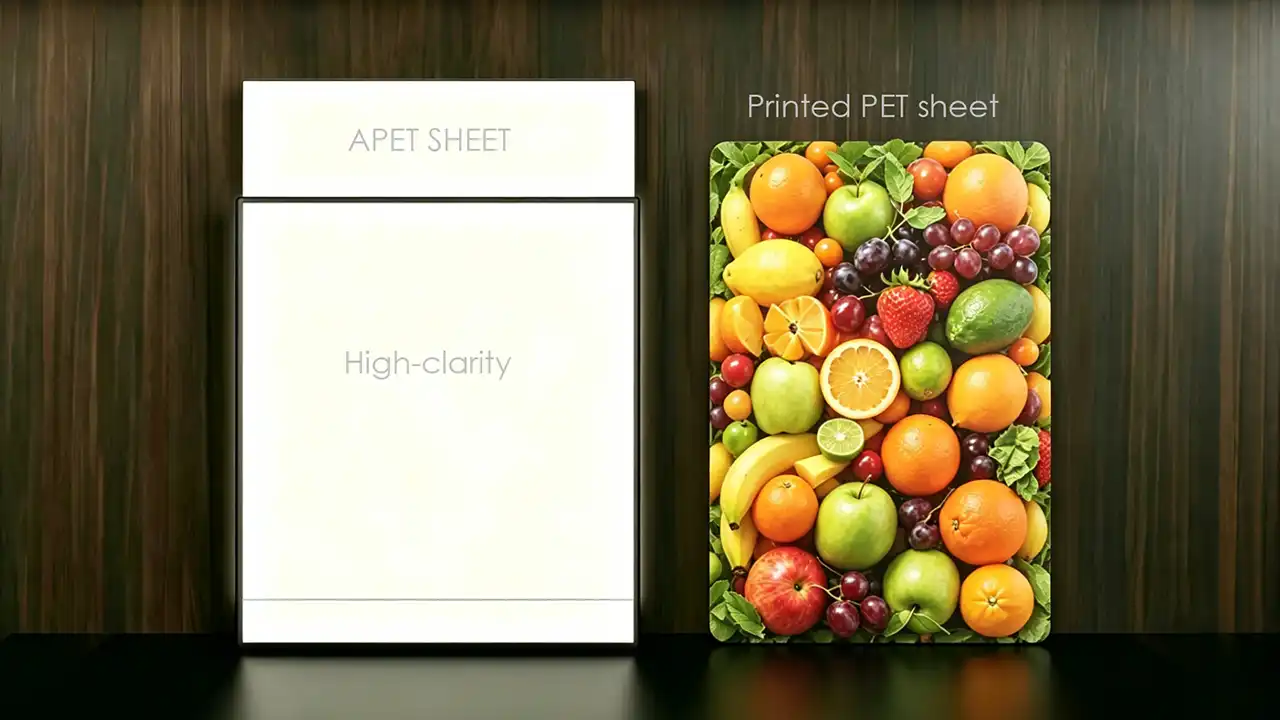
Lightbox Advertising Printing
UV-printable APET sheets deliver vibrant, sharp graphics that drop straight into magnetic, snap and slide-in lightbox frames, plus indoor commercial displays.
What We Check Before a PET Sheet Order Ships
Every pallet leaves only after these six checks. They run on our own bench with the batch in hand — the sheet that gets measured is the sheet that gets packed, and a cut sample of it stays with us against your next order.
Gauge and cut size
Micrometer reading across the sheet at both ends and the middle, not one spot. Gauge to the ordered value, cut size to the drawing, and the two never traded off against each other.
Surface under raking light
Both sides, with the lamp at a low angle: scratches, dust, fisheyes, roll marks. Anything that would read as a streak once the sheet sits behind a lamp is pulled out here.
Ink test on this lot
A cut sample from the batch goes through a small UV or solvent patch. Tape-pull for adhesion, then a look at the edge for bleeding — the sheet on the pallet, not a lab coupon.
Light through the sheet
Sample held over a lightbox tube: even transmission, no hotspots, no yellow cast against the master swatch kept from your previous order.
Flatness and curl
Sheets laid on the bench and left to settle. A sheet that will not lie flat jams a flatbed or walks sideways in a roll printer, and that is a complaint we do not want to inherit.
Packing and paperwork
Interleaved, edge-protected, moisture-barrier wrapped, count re-counted at the pallet. Photos, packing list and the retained sample travel with the shipment.
If a check fails it is re-run or re-made before packing, not negotiated after the container lands. Tolerances are the ones on your drawing and quotation — we do not publish a blanket ± figure, because two jobs never accept the same one.
Frequently Asked Questions About Printable PET Sheets
Our APET/PETG/GAG sheets are optimized for UV printing and screen printing—both widely used in advertising graphic production for high color saturation and durability.
We offer 0.3 mm to 1.0 mm thicknesses — 0.3, 0.4, 0.5, 0.8 and 1.0 mm — with 0.3 mm and 0.4 mm being the most popular for lightbox applications. Custom thickness is available on request.
Dust spots on APET sheets cause defects in printed advertising graphics. Our dust-free workshop ensures 100% clean surfaces for high-quality printing results.
Standard sheet sizes are A4, A3, A2, A1 and 600 × 900 mm. Larger or different sizes can be quoted as custom runs.
Yes. Choose the Custom cell in the thickness or sheet size row, then send us the exact value with your quantity — custom thickness and size are produced to order.
0.3 mm and 0.4 mm cover most lightbox graphics. 0.5 mm, 0.8 mm and 1.0 mm are also available when a thicker, stiffer sheet is needed.
Yes — our printable PET sheets are 100% recyclable, and they stay compatible with both UV and screen printing inks.
Yes, at the edges of the frame more than in the middle. APET and GAG both give an opaque white base that hides the light guide plate — GAG adds a glossier skin over it — while PETG is clear and needs a white backing before it sits in front of LEDs. Fine type and gradients print crisp on all three; PETG has the softest surface and scuffs first.